Visual support in preschool
Practical guide for educators on using visual support in preschool. From daily schedules to communication boards for the whole group.
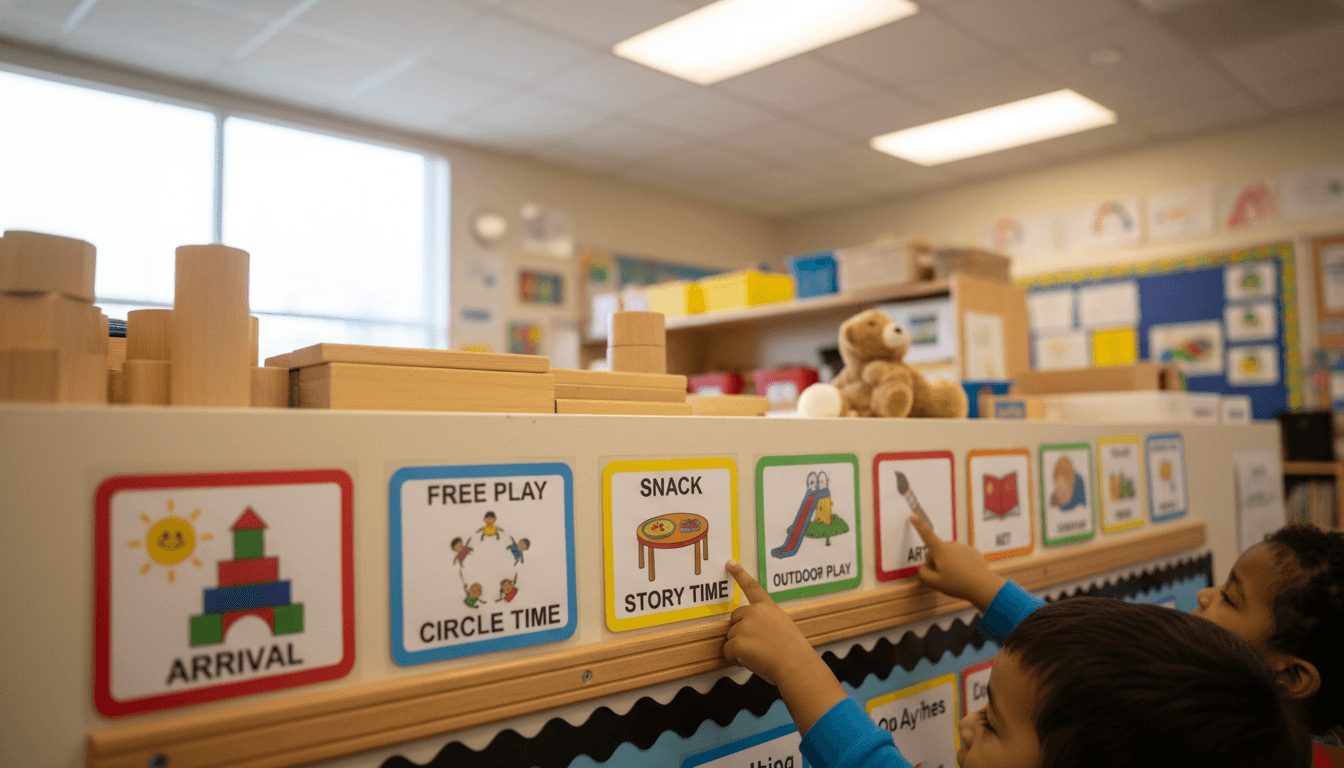
Visual support as a universal tool
In preschool, visual support isn't just for children with special needs — it's a universal pedagogical tool. All children aged 1–6 have limited reading ability and limited working memory. Images help everyone understand routines, rules, and expectations.
Education authorities recommend that preschools use visual support as part of their foundational pedagogy. It's about making the implicit explicit.
Daily schedule for the whole group
A daily schedule on the wall shows the whole group's day: circle time, outdoor play, lunch, rest, snack, activity, pickup. Use large, clear images and go through the schedule at circle time every morning.
Movable images (with velcro or magnets) allow children to move each activity to "done" when it's completed.
Digital schedules on a tablet also work — especially if they have audio that reads each step aloud.
Transitions and signals
Transitions between activities are often chaotic in a group of children. Visual support can help:
Show an image of the next activity 5 minutes before the switch. Use a visual timer that children can see. Have a dedicated "transition card" that signals it's time to change.
Combine visual and auditory signals — for example, a bell together with an image.
Communication boards in the classroom
Place communication boards in strategic locations: at the dining table ("more", "water", "done"), in the hallway ("help", "jacket", "shoes"), at play stations.
These boards help all children — those who aren't yet talking, those with a different native language, and those who struggle to express themselves verbally in a large group.
Make the boards a natural part of the environment. Point to the images yourself as an educator — it normalizes their use.
Individual support
Some children need more individual visual support beyond the group's schedules. Create personal schedules for children who need extra clarity.
First-then boards can be invaluable for children who struggle with transitions.
Collaborate with parents — ideally use the same images and structure at home as in preschool. With PicTalk, you can share schedules via a link.