Communication boards — getting started
Guide to communication boards (AAC). Learn how to build, organize, and introduce boards for people who need augmentative communication.
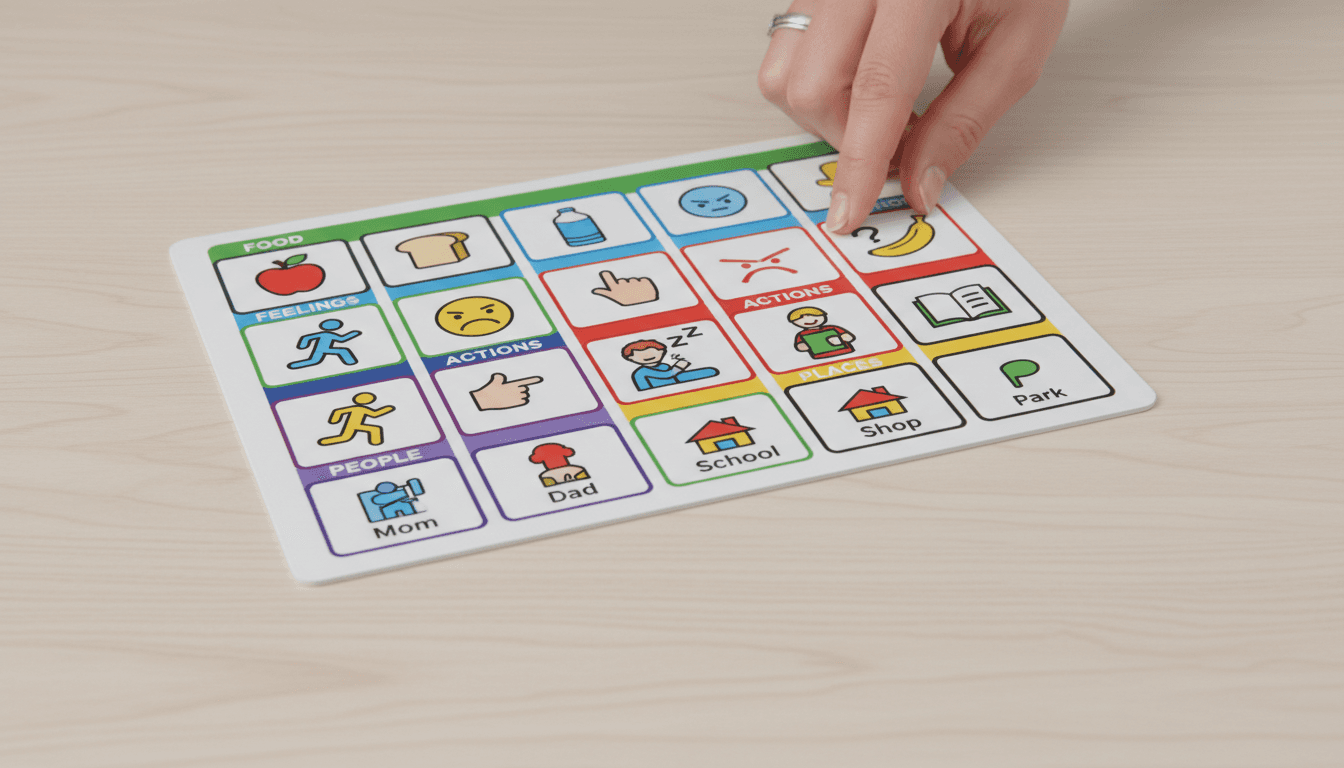
What is a communication board?
A communication board is a collection of images and words organized so that a person can point to communicate. It's a fundamental AAC (Augmentative and Alternative Communication) tool.
Communication boards can be simple — four images with basic needs — or complex systems with hundreds of words organized in categories.
They're used by children and adults who have limited or no spoken language, regardless of the reason: autism, intellectual disability, aphasia after stroke, or motor difficulties affecting speech.
Core vocabulary vs. fringe vocabulary
Core vocabulary consists of the most common words in any language: I, you, want, more, stop, help, big, small, go, eat. About 200–400 words account for 80% of everything we say.
Fringe vocabulary is specific to a place or activity: sandbox, swing, doll.
A good communication board combines both, but always start with core vocabulary. It gives the most communicative power per image.
How to build your first board
Start small — 4 to 9 images. Choose words the person needs often: eat, drink, more, help, stop, yes, no.
Organize logically. Place the most-used words where they're easiest to access. Group similar words near each other.
Use text-to-speech. In PicTalk, the person can tap an image and hear the word — this supports both communication and language development.
Introducing the board
Model the use. Point to the images yourself when talking to the person. "Do you want MORE?" (point to "more"). "Shall we EAT?" (point to "eat").
Keep the board always available. It should be present at all activities, not just during "communication time".
Every time the person uses the board — whether it's perfect or not — respond positively. Communication should always be successful.
Common questions
"Does visual support hinder speech development?" No. Research shows the opposite — AAC supports and often accelerates speech development. The person doesn't get fewer reasons to talk — they get more.
"My child is too young." There's no minimum age. Children can begin using simple picture communication as early as one year old.
"The person understands everything I say." Understanding and expressing are different abilities. A person can have good comprehension but need support to express themselves.