What is visual support?
An introduction to visual support — what it is, why it works, and who benefits from it. A foundational guide for parents, educators, and healthcare professionals.
Visual support in brief
Visual support means using images, symbols, pictograms, and visual schedules to support communication, understanding, and daily functioning. It is one of the most evidence-based methods in AAC (Augmentative and Alternative Communication) and is recommended by health authorities worldwide.
The research is clear: visual information is processed faster and remembered better than verbal information for most people — and especially for individuals with neurodevelopmental conditions or communication difficulties.
Why does it work?
Our brains are wired to process images. While spoken language is fleeting — it disappears the moment it's said — a picture stays. A child can look at the image again and again, at their own pace.
Visual support provides security through predictability. When a child knows what's going to happen next, anxiety and resistance decrease. It also promotes independence — the child can follow the schedule without an adult needing to repeat instructions.
Studies show that visual support reduces challenging behavior, increases cooperation, and improves participation in daily life.
Who benefits from visual support?
Visual support was originally developed for individuals with autism and intellectual disabilities, but research shows it helps a much broader group:
Children with autism need predictability and clear structure. Visual schedules reduce anxiety during transitions and help the child understand expectations.
Children with ADHD often struggle with time perception and sequencing. Visual schedules provide external structure that helps them stay focused.
People with aphasia after stroke can use communication boards to express needs and participate in conversations.
Newly arrived children who don't yet speak the local language can understand routines and instructions through pictures.
In fact, all children — not just those with diagnoses — benefit from visual support. Many preschools use visual schedules for the entire class.
Types of visual support
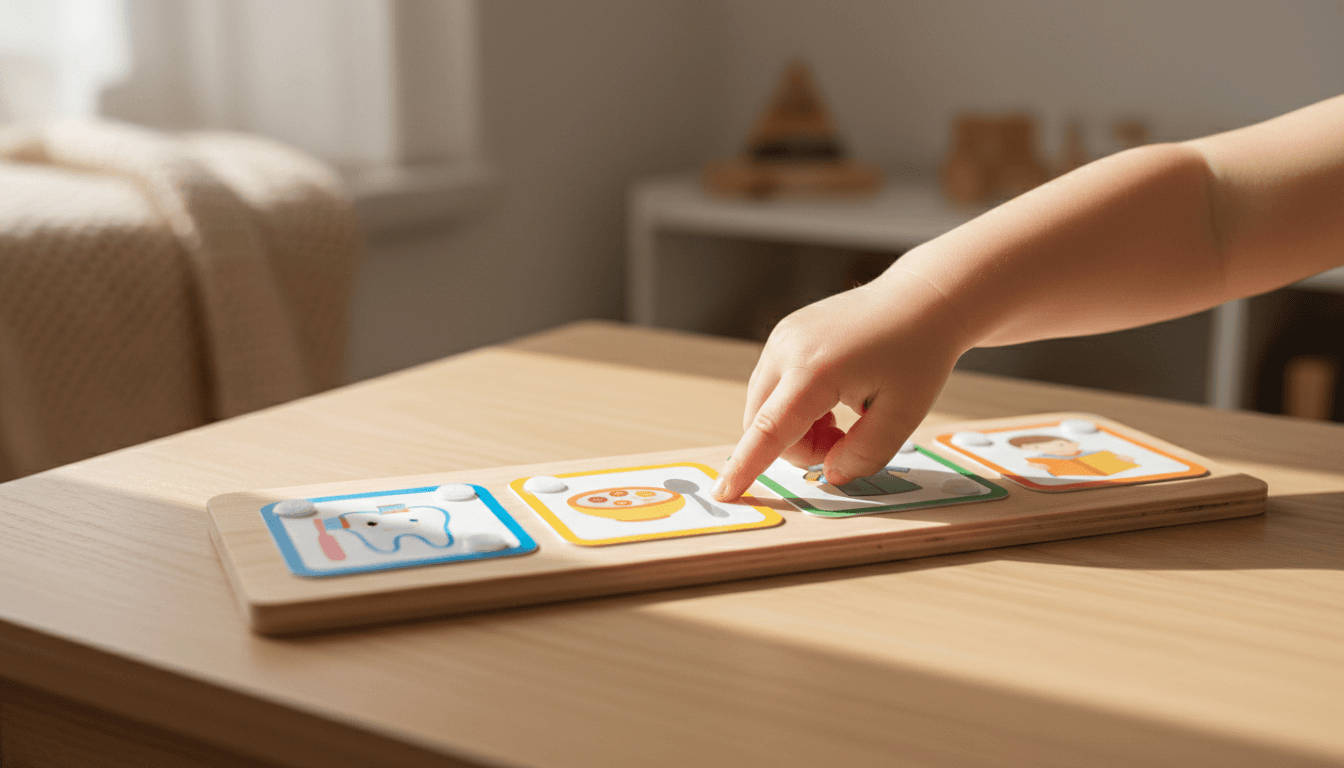
Visual schedules — step-by-step schedules showing what will happen, in what order. Perfect for morning routines, school days, and bedtime routines.
First-then boards — show two steps: "first we do this, then we do this". Great for transitions and motivation.
Choice boards — display multiple options for the child to choose from. Gives the child agency and reduces frustration.
Communication boards — collections of images and words that a person can point to in order to communicate. A fundamental AAC tool.
Social stories — short illustrated stories that prepare a child for new situations.
Getting started with visual support
You don't need special training to start using visual support. Start simple — pick a routine that's challenging (for example, the morning routine) and create a schedule with 5–7 steps.
Use clear, simple images. Pictograms in a consistent style work better than photos for most purposes. Place the schedule where the child can see it — on the fridge, on the hallway wall, or on a tablet.
With PicTalk, you can create a visual schedule in under a minute. Choose a ready-made template or build your own from scratch.